T1 and T2 relaxation#
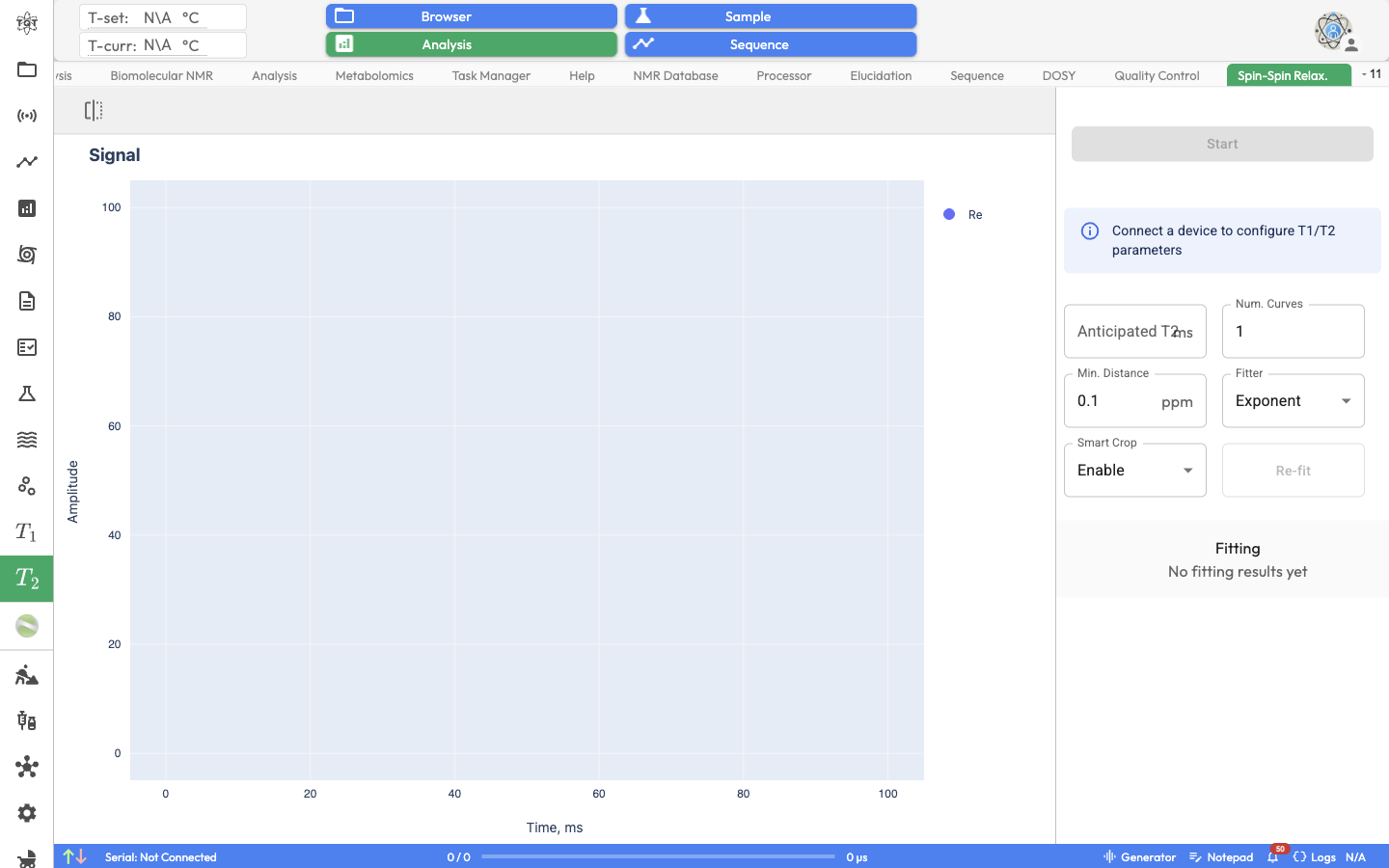
Two pages measure relaxation times with fixed sequences: Spin-Lattice Relax. measures T1 by inversion recovery, and Spin-Spin Relax. measures T2 with a CPMG echo train. Both acquire a decay curve and fit it in the same pass.
Enter the anticipated relaxation time, set the acquisition parameters, and press START. Support is per device — a device that cannot do one of the measurements says so rather than offering the controls.

T1 parameters#
| Parameter | What it sets |
|---|---|
| Anticipated T1 | Your estimate, in milliseconds. Required before Auto is available, and used to derive the sweep. |
| Num. Scans | Repetitions averaged per point. More scans, better signal-to-noise, longer experiment. |
| Num. Points | How many points make up the recovery curve. |
| Acquisition Time | How long data is collected after each inversion. |
| Start Time | The shortest inversion-recovery delay — the first point on the curve. |
| Period | The longest delay — the last point on the curve. |
| Smart Crop | Trims the acquired window to the part that carries signal. |
T2 parameters#
| Parameter | What it sets |
|---|---|
| Anticipated T2 | Your estimate, in milliseconds. |
| Num. Scans | Repetitions averaged per echo. |
| Num. Echos | Echoes collected in the CPMG train — the number of points on the decay curve. |
| Echo Time | The spacing τ between the 90° pulse and the first 180°, and thereafter between echoes. |
| Decimation | Records only every n-th echo. For a long T2 this covers more of the decay in the same time. |
| Acquisition Time | How long each echo is sampled for. |
| Smart Crop | Trims the acquired window to the part that carries signal. |
Auto runs a device sweep to find these parameters and overwrites what is currently set, so it asks for confirmation first. It needs an anticipated value to start from.
Fitting#
The decay is fitted as a sum of exponentials; Num. Curves sets how many. The fit table reports the relaxation time as a headline, the fit quality as R², and the fitted parameters — scale, T, X₀ and Y₀ — for each curve. Where the fit resolves more than one population, each group is reported separately.
Re-fit refits the data already acquired without re-running the experiment, which is how you try a different number of curves.
The result can be written back to the Sample as the observed T1 or T2, alongside the anticipated value you started from.
Note
Relaxation times depend on temperature. Record the sample temperature with the measurement, or comparisons across sessions will not mean much.